Home · Blog · Cultural Weddings
Multicultural & Religious Weddings in Ottawa
Greek Orthodox, South Asian, Muslim, Jewish and East Asian ceremonies — what happens in each, and how to tell whether a photographer actually knows.
Home · Blog · Cultural Weddings
Greek Orthodox, South Asian, Muslim, Jewish and East Asian ceremonies — what happens in each, and how to tell whether a photographer actually knows.
Ottawa is one of the most culturally varied cities in Canada, and its weddings reflect that. In a single season we might film a Greek Orthodox crowning, a three-day South Asian celebration, a Nikah, and a Jewish ceremony under a chuppah. Each has a structure, and each has moments that are easy to miss if the person holding the camera does not know they are coming.
This is a practical guide for couples planning a cultural or religious wedding in Ottawa — and for working out whether a photographer actually understands yours.
A wedding photographer who has only shot civil ceremonies will still take good pictures at a Greek Orthodox wedding. But they will not know that the crowning happens behind the couple, that the Dance of Isaiah moves without warning, or that the most emotional thirty seconds of the entire service may happen with the priest's back to the room.
These are not things you can learn on the day. The single most useful question you can ask any photographer is: have you filmed this specific ceremony before, and what happens in it? The answer tells you everything.
Long services, usually between forty-five and ninety minutes, with two distinct halves — the betrothal and the crowning. Key moments are the exchange of rings, the placing and swapping of the stefana, the shared cup, and the Dance of Isaiah, when the couple circle the altar three times.
Practical notes: many Ottawa Orthodox churches restrict movement during the service, so positions must be agreed with the priest beforehand. Interiors are often dark with strong colour casts from stained glass. Two cameras genuinely help here, because the crowning and the couple's faces happen on opposite sides.
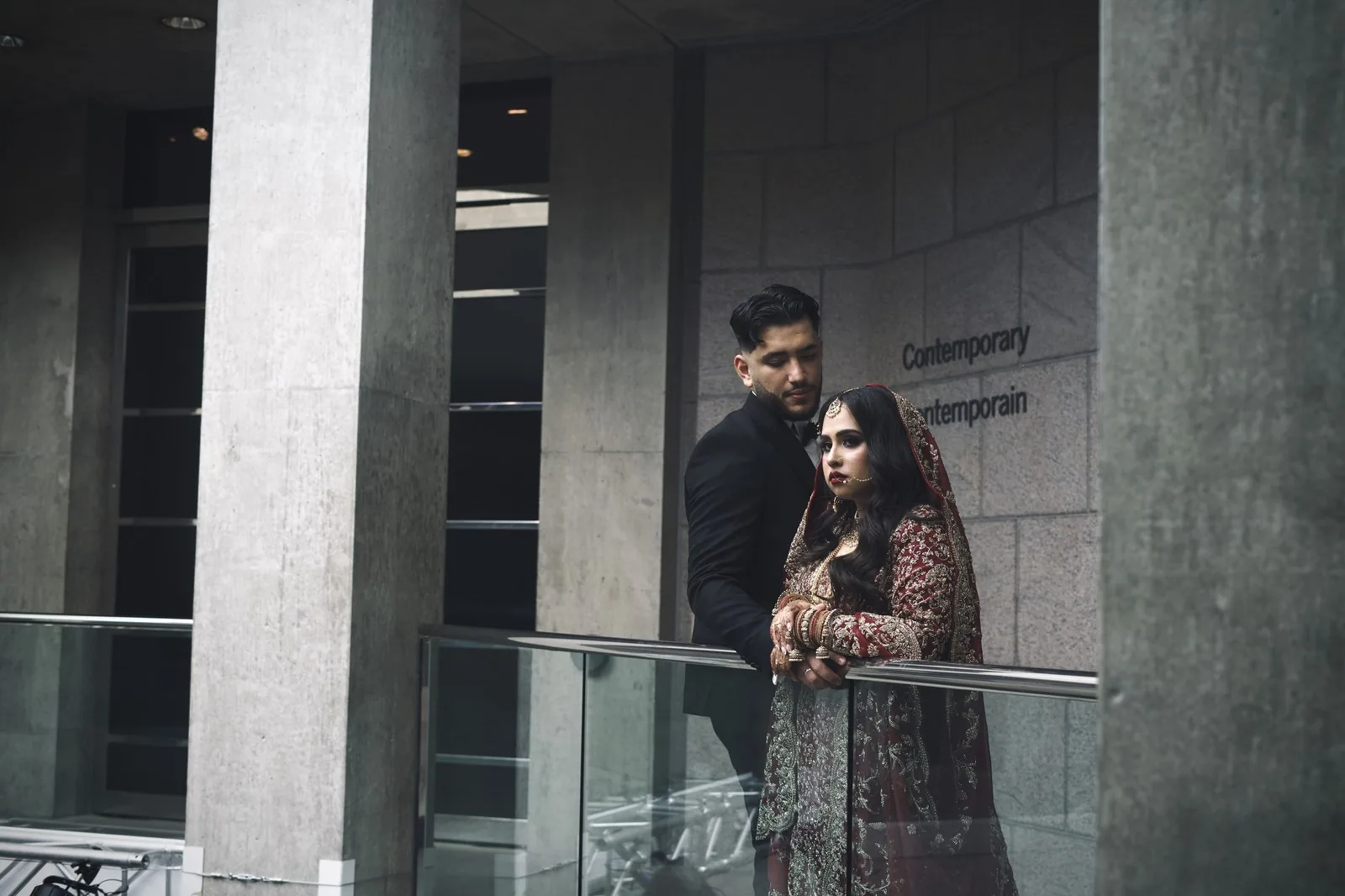
Frequently multi-day — a mehndi, a sangeet, the baraat, the ceremony itself, and a reception, sometimes across three or four days and multiple venues. Ottawa has a large South Asian community and venues like Infinity Convention Centre and Sala San Marco host these regularly.
Practical notes: the baraat is loud, mobile and unrepeatable, and needs someone who knows to shoot it walking backwards. Ceremonies under a mandap can run two hours with the couple's faces partly turned away. Colour is central to the day and demands careful white balance — the reds and golds that make these weddings extraordinary are exactly what cheap editing destroys.
Coverage is usually quoted per event rather than as one block. Because we bill hourly, a mehndi on Friday and a ceremony on Sunday are simply two bookings at the same rate.
The Nikah itself can be brief — sometimes under half an hour — with the celebration built around the walima. Some families request gender-segregated coverage, which means a female photographer for the women's side.
Practical notes: ask early whether segregated coverage is needed, because it determines who we assign. Some mosques restrict photography during the Nikah; this is worth confirming weeks ahead rather than on the morning.
Structured around the ketubah signing, the bedeken, the ceremony under the chuppah, the breaking of the glass, and the hora. Orthodox and Conservative ceremonies may include a yichud immediately afterwards, during which the couple are alone — a natural gap that a photographer who knows the tradition will have planned around rather than been surprised by.
Practical notes: some observant families do not permit photography on Shabbat or during certain parts of the service. The hora is chaotic, joyful and the single best photographic opportunity of the night.
Often combine a tea ceremony with the couple's families, a Western-style ceremony, and a multi-course banquet with several outfit changes. The tea ceremony is intimate, usually in a small room with poor light, and it is where the most meaningful family moments happen.
A note on hours. Cultural weddings frequently run longer than couples budget for. A ceremony scheduled for an hour that runs ninety minutes will push everything after it. We bill by the hour at the same rate throughout, so a day that runs long is never an overtime penalty — but it is worth building the extra time into the booking rather than discovering it at eleven at night.
Before any cultural or religious wedding, our Creative Director builds a written game plan with you — the running order, the moments that matter, who is covering what, and where each camera will be standing during the parts of the service where movement is restricted. For ceremonies we have not filmed before, we speak with the officiant beforehand.
We have covered Greek Orthodox, South Asian, Muslim, Jewish and multi-day cultural celebrations across the National Capital Region. If yours is a tradition we have not yet filmed, we will say so plainly and tell you how we would prepare for it.
Let's Work Together
Tell us about your event and we'll help you figure out the right coverage — no pressure, just a conversation.

We'll reach out within 24 hours to discuss your vision and availability.
We'll be in touch within 24 hours to discuss your date and everything we can do for you.